
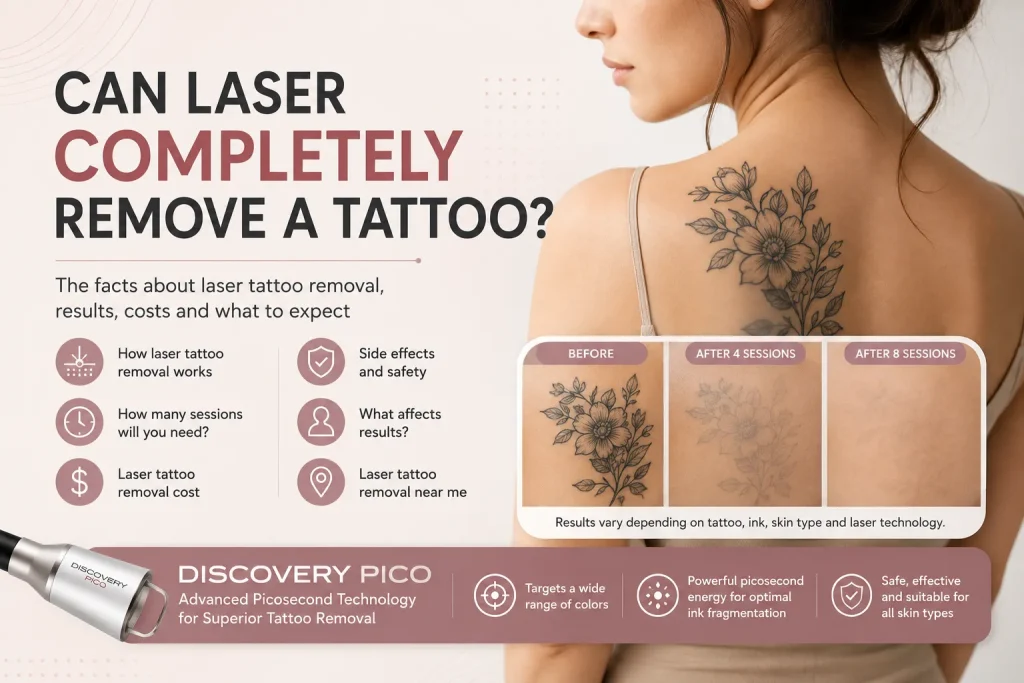
If you regret a tattoo, you may be wondering: Can laser completely remove a tattoo? The short answer is sometimes, but not always. Modern laser technology can significantly fade or even completely clear many tattoos, but the final result depends on factors such as ink color, tattoo depth, age, size, location, skin type, and the laser technology used.
For people looking for the most advanced approach to laser tattoo removal, picosecond technology has become an important option. Among modern picosecond systems, Discovery Pico stands out because it combines multiple wavelengths with very short picosecond pulses, allowing practitioners to target a wider range of tattoo pigments.
However, no reputable provider should promise that every tattoo can be removed 100%. The FDA notes that complete tattoo removal may require many treatments and, in some cases, may not be possible.
Table of Contents
Can laser completely remove a tattoo?
Yes, laser tattoo removal can sometimes completely remove a tattoo, but 100% removal cannot be guaranteed for every tattoo.
Laser treatment works by delivering specific wavelengths of light into the tattooed skin. The laser energy breaks tattoo pigment into much smaller particles, which the body’s immune system gradually clears.
This is why tattoo removal is not an instant process. The laser does not simply “erase” the tattoo during one appointment. Instead, each session breaks down more pigment, and the body needs time between treatments to clear those particles and for the skin to recover.
What determines whether a tattoo can be completely removed?
Several factors influence the final result:
- Tattoo color: Black and dark blue inks are generally easier to treat, while green, yellow and some red pigments can be more challenging.
- Ink depth: Deeply deposited pigment may require more sessions.
- Tattoo age: Older tattoos may have already faded, which can make treatment easier in some cases.
- Tattoo size: Larger tattoos naturally require more treatment time.
- Location: Tattoos in areas with different circulation and skin characteristics can respond differently.
- Ink composition: Modern tattoo inks contain a wide variety of pigments, and some respond better to particular wavelengths.
- Skin type: Laser settings must be carefully selected according to the patient’s skin tone and the pigment being treated.
- Laser technology: Different wavelengths and pulse durations are suited to different tattoo pigments.
The American Academy of Dermatology similarly emphasizes that tattoo characteristics—including color, depth, location and age—affect the treatment plan and expected outcome.
Does Laser Hair Removal Affect Fertility? What Science Says
How does laser tattoo removal work?
Laser tattoo removal uses selective photothermal or photoacoustic effects to target tattoo pigment while minimizing damage to the surrounding skin.
Traditional Q-switched lasers have been used for many years, but picosecond laser technology uses extremely short pulses measured in trillionths of a second.
These very short pulses can create a strong photoacoustic effect that fragments pigment into smaller particles.
The body then gradually removes these fragments through its natural immune and lymphatic processes.
This is one reason why laser tattoo removal before and after photos are usually taken across multiple treatment sessions rather than immediately after the first appointment.
Research supports picosecond lasers as an effective tattoo-removal technology, with evidence suggesting particular advantages for some difficult pigment colors. A systematic review found that picosecond lasers showed superiority for blue, green and yellow pigments, while both picosecond and Q-switched lasers were effective for black tattoos.
Best Laser for Acne Scars and Hyperpigmentation: Why Discovery Pico Stands Out
Is 100% tattoo removal possible?
100% tattoo removal is possible for some tattoos, but it is not guaranteed.
A tattoo that becomes virtually invisible after treatment may be considered a highly successful result, even if a very small amount of residual pigment remains.
Some tattoos are considerably more difficult to remove than others. For example, certain light-colored pigments, cosmetic tattoo pigments and white or flesh-colored inks can behave unpredictably during laser treatment.
The FDA specifically notes that some white and flesh-colored pigments can oxidize and become darker when exposed to laser energy, making them particularly challenging to treat.
Therefore, the realistic goal should be maximum safe pigment clearance, rather than promising complete removal before the tattoo has been assessed.
What tattoos are hardest to remove?
Some of the most challenging tattoos include:
Green tattoos
Green pigment can be difficult to remove because different shades of green may respond differently to laser wavelengths.
Yellow tattoos
Yellow is among the more difficult tattoo colors to treat and may require a specialized approach.
Multicolored tattoos
A multicolored tattoo may require more than one wavelength because different pigments absorb different wavelengths of light.
White and flesh-colored tattoos
These can be particularly unpredictable. Some pigments may darken after laser exposure rather than immediately fading.
Deep or heavily saturated tattoos
When large amounts of pigment have been deposited deeply into the skin, multiple treatment sessions may be required.
This is one reason laser tattoo removal should be planned around the actual tattoo rather than simply using the same laser and settings for every patient.
Ultraformer Before and After: What Results Can You Really Expect?
Why Discovery Pico is one of the strongest options for tattoo removal
When the goal is to remove a tattoo as completely as possible, laser selection matters.
Discovery Pico by Quanta System is a highly advanced picosecond laser platform specifically designed for applications including tattoo removal.
One of its major advantages is its wavelength versatility. The Discovery Pico Series can offer 1064 nm, 532 nm and, on the Plus version, 694 nm wavelengths. This allows practitioners to select the wavelength according to the tattoo pigment being treated.
The platform also uses extremely short picosecond pulses and high peak power to create a strong photoacoustic effect that fragments tattoo pigments.
Why does this matter?
A common misconception is that there is one universal “tattoo removal laser.”
There isn’t.
Different tattoo pigments absorb different wavelengths. Having access to multiple wavelengths can therefore give a qualified practitioner more flexibility when treating complex or multicolored tattoos.
This is one of the reasons Discovery Pico is considered one of the best options for advanced tattoo removal, particularly when treating tattoos containing multiple colors or pigments that can be difficult to target with a single wavelength.
Discovery Pico vs. traditional tattoo removal lasers
| Feature | Traditional Q-switched laser | Discovery Pico |
|---|---|---|
| Pulse duration | Nanoseconds | Picoseconds |
| Tattoo removal | Yes | Yes |
| Multiple wavelengths | Depends on device | Up to 3 wavelengths |
| Photoacoustic effect | Yes | Strong picosecond photoacoustic effect |
| Multicolored tattoos | May require different devices | Greater wavelength versatility |
| Difficult pigments | Depends on wavelength | Designed for broad pigment targeting |
| Treatment customization | Device-dependent | Multiple pulse/wavelength options |
This does not mean that every tattoo will disappear faster with Discovery Pico or that every patient will need fewer sessions. Treatment outcomes depend on the tattoo, the patient’s skin, the pigment and the clinician’s technique.
The advantage is that Discovery Pico gives practitioners a sophisticated platform with multiple wavelengths and pulse options to tailor treatment more precisely.
Discovery Pico vs PicoSure: A Dermatologist’s Complete Comparison Guide
How many sessions does laser tattoo removal take?
There is no fixed number of sessions that works for everyone.
Some tattoos may require only a handful of treatments, while others can require considerably more.
The FDA notes that tattoo removal generally requires multiple treatments separated by several weeks, and complete removal may take many sessions.
The number of sessions can depend on:
- Tattoo color
- Ink density
- Tattoo size
- Tattoo location
- Ink depth
- Skin tone
- Age of the tattoo
- Type of laser
- Wavelength used
- How the skin responds to treatment
It is also important not to treat the same area too aggressively or too frequently simply to achieve faster results. The skin needs time to heal, while the body needs time to clear the fragmented pigment.
What does laser tattoo removal feel like?
Laser tattoo removal can be uncomfortable, although the sensation varies from person to person. Patients often describe the sensation as a series of quick snaps or pinpricks against the skin.
Depending on the tattoo and treatment area, a practitioner may use cooling methods or topical/local anesthetic measures to improve comfort.
Temporary redness, swelling, tenderness and blistering can occur after treatment. Changes in pigmentation can also occur, particularly depending on the patient’s skin type and treatment settings.
What are the downsides of laser tattoo removal?
Although modern laser tattoo removal is generally considered safe when appropriately performed, it is not completely risk-free.
Potential side effects include:
- Redness
- Swelling
- Temporary tenderness
- Blistering
- Changes in skin pigmentation
- Hypopigmentation
- Hyperpigmentation
- Rarely, scarring or changes in skin texture
The risk of complications increases when laser treatment is performed without appropriate medical knowledge, incorrect settings are used, or aftercare instructions are not followed.
For this reason, choosing an experienced medical professional is just as important as choosing the laser itself.
Can laser tattoo removal cause cancer?
One of the questions people frequently search for is “tattoo removal side effects cancer.”
Current evidence does not establish laser tattoo removal as a cause of cancer. However, the FDA notes that scientists do not yet know all of the short- and long-term consequences of how tattoo pigments break down after laser treatment.
It is important to distinguish this from concerns about tattoo inks themselves. Research into the possible long-term health effects of tattoo pigments is ongoing, and current epidemiological evidence regarding cancer risk from tattoos remains inconclusive.
Laser tattoo removal should therefore be approached as a medical aesthetic procedure that requires proper patient assessment and appropriate laser selection—not as a procedure that can be considered completely risk-free.
Duetto Laser Hair Removal: The Best Guide to Treatment
Can a large tattoo be removed?
Yes, large tattoos can be treated with laser tattoo removal, but they usually require more treatment time and potentially more sessions.
The size of the tattoo does not automatically mean that it cannot be removed. Instead, the practitioner needs to consider the tattoo’s pigment, depth, location and the patient’s skin.
Large tattoos may also be divided into treatment areas so that the skin can be managed safely.
For complex large tattoos, the versatility of a platform such as Discovery Pico can be particularly useful because different wavelengths can be selected according to the pigments present.
Can you remove a 20-year-old tattoo?
Yes. A 20-year-old tattoo can still be treated with laser tattoo removal.
In fact, an older tattoo may already have experienced some natural fading. However, age alone does not determine whether the tattoo can be completely removed.
A 20-year-old tattoo containing dense, deeply deposited pigment may still be difficult to clear, while an older, faded tattoo may respond more readily.
The best way to estimate the expected outcome is through an individual assessment rather than judging the tattoo only by its age.
Laser tattoo removal before and after: What should you expect?
When looking at laser tattoo removal before and after results, remember that photographs can be misleading if they do not show:
- The number of treatment sessions
- The time between photographs
- The laser technology used
- The tattoo’s original colors
- The patient’s skin type
- Whether any pigment remains
A realistic treatment journey usually shows gradual fading rather than the tattoo disappearing immediately.
After each session, the tattoo may become progressively lighter as additional pigment particles are fragmented and cleared.
How does laser tattoo removal compare with other methods?
Laser treatment has become the primary professional method for removing tattoos because it can target pigment without surgically removing large areas of skin.
Other approaches, such as surgical excision or dermabrasion, may be appropriate in selected circumstances but have different limitations and risks.
The FDA identifies laser tattoo removal as the most common professional method and notes that treatment should be performed using the appropriate laser under the supervision of a qualified healthcare professional.
For patients seeking maximum pigment clearance while minimizing unnecessary skin injury, modern picosecond laser technology offers an important advancement over older approaches.
What is the best laser for tattoo removal?
There is no single laser that is automatically the best for every tattoo.
However, Discovery Pico is one of the strongest options for advanced tattoo removal, particularly because of its combination of picosecond technology, high peak power and multiple wavelengths.
Its 1064 nm and 532 nm wavelengths, with an additional 694 nm wavelength available on the Discovery Pico Plus, provide greater flexibility when treating different tattoo pigments.
Scientific reviews also support the effectiveness of picosecond lasers for tattoo removal, particularly for certain difficult colors.
Ultimately, the best tattoo removal treatment is the combination of the right laser, the right wavelength, appropriate settings and an experienced practitioner.
Frequently Asked Questions
Can laser completely remove a tattoo?
Sometimes. Some tattoos can be completely or almost completely cleared, but 100% tattoo removal cannot be guaranteed. The result depends on the tattoo’s pigment, depth, color, size, location and other factors.
Is 100% tattoo removal possible?
Yes, it is possible for some tattoos, but not for every tattoo. Some pigments are particularly resistant to laser treatment.
How many sessions are needed for laser tattoo removal?
The number varies considerably. Many tattoos require multiple sessions separated by several weeks, and difficult tattoos may require numerous treatments.
What tattoos are hardest to remove?
Green, yellow and certain red pigments can be difficult to remove. White, flesh-colored and some cosmetic tattoo pigments can also be challenging because of their unpredictable response to laser treatment.
Can a large tattoo be removed?
Yes. Large tattoos can be treated, although they may require more treatment time and multiple sessions.
Can you remove a 20-year-old tattoo?
Yes. Tattoo age does not prevent laser removal. The pigment’s color, depth, density and composition are more important factors.
How does laser tattoo removal feel?
Most patients experience a brief snapping or stinging sensation. Cooling and appropriate anesthetic measures can help make treatment more comfortable.
Is laser tattoo removal safe?
Laser tattoo removal can be safe when performed with an appropriate device, correct settings and proper medical supervision. The choice of practitioner is an important part of reducing complications.
How do I find laser tattoo removal near me?
Look for a qualified medical provider with experience in tattoo removal and access to appropriate wavelengths for your tattoo. Ask what laser technology they use, how they approach different ink colors and whether they can show genuine laser tattoo removal before and after results.
The Bottom Line: Can Laser Completely Remove a Tattoo?
Laser can completely remove some tattoos, but complete removal is not guaranteed. The most important factors are the tattoo’s ink colors, depth, density, size, location and the technology used.
For patients looking for an advanced tattoo-removal solution, Discovery Pico is a particularly strong option. Its picosecond technology, high peak power and multi-wavelength platform give practitioners greater flexibility when treating different tattoo pigments, including complex and multicolored tattoos.
If your goal is to achieve the maximum possible tattoo clearance with modern laser technology, the best approach is to have the tattoo assessed individually and determine which Discovery Pico wavelength and treatment strategy are appropriate.
Looking for advanced tattoo removal technology?
Discover Discovery Pico—an advanced picosecond laser platform designed for tattoo removal and pigment treatments.
If you’re a clinic or aesthetic professional looking to offer advanced laser tattoo removal, explore Discovery Pico and learn how its multi-wavelength technology can expand your treatment capabilities.
Talk to Emkanat about Discovery Pico today.