
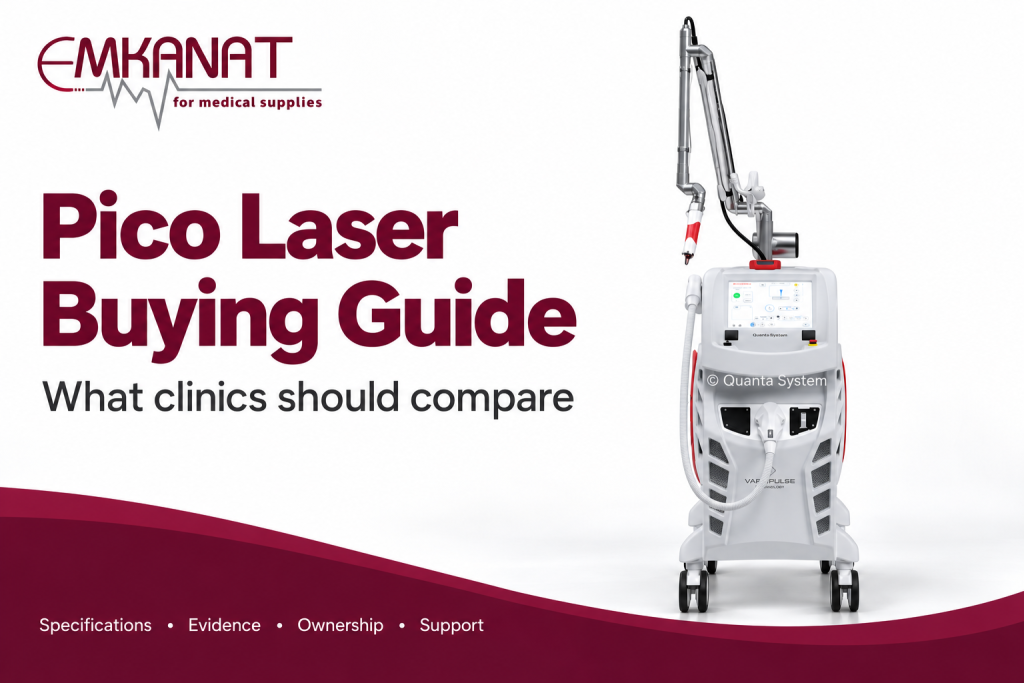
Choosing a pico laser machine starts well before comparing quotations. A clinic treating mostly tattoos needs to ask different questions from one building a pigmentation service or adding scar procedures. Even machines carrying the same “picosecond” label can differ in the wavelengths, optics and operating modes included.
I would begin with the work the clinic intends to do, then ask for the configuration, evidence and support needed to deliver that work responsibly. This guide explains what to compare, where technical claims need context and how to assess the cost of ownership. Emkanat can help qualified clinic buyers discuss the equipment available for their location.
Choosing a Pico Laser Machine: The Short Answer
Choose a pico laser machine by matching its documented wavelengths, pulse durations and handpieces to your clinic’s intended services. Compare specifications under equivalent operating conditions, examine evidence for the proposed applications and obtain written ownership and support terms. The right purchase is a configuration your qualified team can use effectively and maintain reliably.
What Makes a Laser Picosecond?
A picosecond is one trillionth of a second; a nanosecond is one billionth. In a laser specification, pulse duration describes how briefly an individual pulse delivers energy. The word “picosecond” therefore describes timing. It does not identify a single wavelength, a complete treatment protocol or a guarantee of results.
When comparing equipment, distinguish picosecond pulses from nanosecond pulses. “Q-switched” and “picosecond” are not mutually exclusive descriptions: published research describes picosecond-domain Q-switched lasers. A comparison should identify the actual pulse duration rather than rely on a simplified “pico versus Q-switched” label.
Very short pulses can produce strong photomechanical effects in pigment treatment, but thermal effects remain relevant. Avoid equating “pico” with “no heat,” no tissue injury or suitability for every patient. The wavelength, delivery optics and clinical protocol still matter.
Start With the Work Your Clinic Intends to Do
Tattoo removal
List the kinds of tattoos your clinic expects to assess: colours, sizes, cosmetic tattoos and previously treated cases. Ask which wavelengths and accessories support the proposed applications, and what evidence exists for those combinations. Do not treat the number of wavelengths as a score.
Ink colour is only part of assessment. The FDA’s tattoo-removal guidance explains that different colours respond to different laser wavelengths and that complete removal is not always possible. Equipment marketing should not become a promise of complete clearance or a fixed treatment course.
Pigmentation
“Pigmentation” covers different clinical problems. Melasma, post-inflammatory hyperpigmentation and other pigmented lesions should not be grouped into a universal protocol. The practitioner’s diagnosis determines whether a laser is appropriate and what evidence is relevant.
For example, a randomized melasma trial published in 2023 recorded post-inflammatory hyperpigmentation and recurrence in both picosecond treatment groups. This is a reason to assess the evidence carefully, rather than assume a short pulse eliminates pigment-related risks.
The American Academy of Dermatology’s melasma guidance places treatment within a broader plan involving sun protection, medication and, in selected cases, procedures. An equipment demonstration should therefore answer a purchasing question; it cannot determine whether a particular patient needs a laser.
Acne scars and fractional applications
Ask about the exact fractional handpiece, its intended use and studies using that configuration. Fractional optics create patterned delivery; tissue effects and recovery depend on the wavelength, handpiece and protocol. A fractional pico handpiece is not a CO₂ laser, and not every fractional picosecond application is non-ablative. Published research includes ablative picosecond resurfacing.
Build the equipment specification around services the clinic can support clinically, rather than every application mentioned in a sales presentation.
Specifications That Deserve a Proper Comparison
Ask suppliers to complete the same comparison sheet. Every figure should identify the model, wavelength, handpiece and operating conditions. This makes differences easier to interpret and exposes gaps that a headline specification can conceal.
| What to compare | Evidence to request | Why it matters |
|---|---|---|
| Pulse duration | Duration for each wavelength and relevant operating mode. | A platform may provide more than one pulse type; the pico label does not describe every function. |
| Wavelengths | Included wavelengths, optional wavelengths and their documented applications. | Confirms whether the quoted configuration supports the intended service mix. |
| Pulse energy | Delivered energy under stated wavelength, spot-size and repetition-rate conditions. | A maximum value alone does not show the operating performance relevant to your comparison. |
| Spot sizes | Available sizes for each compatible handpiece, including any operating restrictions. | Helps assess configuration and workflow without assuming every size works with every mode. |
| Repetition rate | Supported pulse frequency at the conditions being compared. | Clarifies delivery capability; it does not independently determine appointment time. |
| Beam profile | Manufacturer documentation and measurement information for the supplied optics. | Supports evaluation of energy distribution rather than reliance on a descriptive label. |
| Handpieces | Exact part numbers, compatibility, intended uses and inclusion in the quotation. | Prevents optional accessories or separate modalities being mistaken for standard equipment. |
| Regulatory and clinical evidence | Current local registration, instructions for use and studies for the proposed application. | Separates permitted uses and clinical support from broader marketing claims. |
Read pulse duration, energy and repetition rate together. Ask whether the shortest advertised pulse and highest energy are available under the same conditions. If two brochures quote different wavelengths or handpieces, those headline figures do not provide a like-for-like comparison.
A larger maximum specification is not, by itself, evidence of better clinical outcomes. I would ask the supplier to show the proposed configuration in operation and explain the documentation behind its claims.
When reviewing a clinical study, check the device, handpiece, patient population, comparator and follow-up period. Research using another brand can inform understanding of the technology, but does not establish the same outcome for the system being quoted. Photographs and testimonials may illustrate an individual experience; they cannot replace evidence relevant to the proposed treatment.
Ask Emkanat for a configuration and specification review for your clinic.
Discovery Pico: A Practical Configuration Example
The current Quanta System Discovery Pico page lists 370 ps at 532 nm and 450 ps at 1064 nm. It identifies a 694 nm ruby wavelength with the Plus version and describes ruby operation in Photo-Thermal mode. This illustrates why every wavelength and mode on a pico platform should not be labelled picosecond.
Quanta also describes OptiBeam II square, round and fractional optics. Ask which model and handpieces are included in the local quotation; do not assume Discovery Pico, Plus, Derm or an older START package share identical features.
Use Emkanat’s Discovery Pico product page for a branded enquiry, or explore its Quanta System portfolio. If you are comparing named platforms, the separate Discovery Pico vs PicoSure comparison provides further product context.
Pico Laser Machine Price and Total Ownership Cost
A professional pico laser machine price should describe an identifiable equipment package. Patient session fees answer a different question and should not be used to estimate the purchase price or profitability of a clinic-owned system.
| Cost group | What to include in the comparison | What to verify |
|---|---|---|
| Initial purchase | Console, included optics, optional accessories, delivery, installation and applicable charges. | An itemized quotation identifying the exact supplied package. |
| Ongoing ownership | Maintenance, inspections, repairs, replacement components and refresher training where applicable. | Written service scope, exclusions and replacement arrangements. |
| Cost of providing treatment | Staff and room time, required supplies and an allocation of equipment costs. | Clinic-specific inputs and realistic operating capacity. |
Compare equivalent quotations
Check the console, wavelengths, handpieces, accessories, delivery, installation and training. Identify taxes, financing costs and other applicable charges. A lower initial quotation may exclude components another supplier includes, so compare the written scope before comparing totals.
Account for operating costs
Ask which components require periodic replacement, inspection or servicing. Confirm any consumables, approved cleaning supplies and protective equipment the clinic must budget for. Do not assume all pico machines have the same maintenance requirements or that a handpiece has an unlimited working life.
Include staff and room time, scheduled maintenance, repair arrangements and an appropriate allocation of capital costs when evaluating the service. Use written local inputs rather than an overseas estimate presented as a universal machine price.
Use realistic demand assumptions
Review your clinic’s actual enquiries, patient suitability and available operating capacity. A proposed service needs a credible clinical and operational basis. Revenue projections built on full appointment books or guaranteed premium fees can make almost any purchase look attractive on paper.
Ask what happens while the machine is being serviced. A clear repair process and replacement-part arrangements may matter more to a clinic than a small difference in the initial quotation.
Request a written breakdown of equipment, training, warranty and service terms.
Supplier Documentation, Training and Room Preparation
Confirm what is being supplied
Request the exact model, serial-number documentation, accessories, current instructions for use and locally applicable registration information. Where authorization or distribution status is claimed, ask for documentation that applies to the equipment and market concerned.
International clearance and a manufacturer’s global application list do not establish local permission for every proposed treatment. The clinic should also confirm who may legally operate the device.
Plan training and laser protection
Training needs to cover patient assessment, the supplied handpieces, operating controls, safety procedures, aftercare and recognition of adverse effects. Attendance at a demonstration alone does not establish clinical competence.
Before installation, review room access, warning signs, protective eyewear matched to the laser’s wavelengths and required protection level, and the handling of reflective surfaces. Assess ventilation or plume-control requirements where applicable. Follow the manufacturer’s instructions and the local laser-safety requirements for the proposed procedures.
The UK MHRA’s laser-safety guidance provides a technical reference for these considerations. It does not replace the requirements that apply in the clinic’s own country.
Agree service responsibilities
Clarify installation, acceptance checks, preventive maintenance and any required output checks or calibration. Ask who provides technical support, what the warranty covers, which parts are stocked and how faults are escalated. Obtain written response arrangements rather than treating general promises of support as a service agreement.
Emkanat can discuss equipment availability and support enquiries for a clinic’s location. The final quotation should define the agreed responsibilities and inclusions.
Questions to Ask Before Buying
- Which exact model, wavelengths and handpieces are included?
- Which proposed uses are supported by local registration and the current instructions?
- What studies support the applications our clinic intends to offer?
- Are the pulse duration, energy and repetition-rate figures quoted under comparable conditions?
- Which accessories are optional, and what do they add to the total cost?
- What installation and laser-protection measures are required?
- Who may operate the device, and what training is included?
- Which components have replacement, maintenance or inspection requirements?
- What does the warranty exclude, and how are repairs handled?
- Can we review the documentation and see the quoted configuration demonstrated?
Frequently Asked Questions
Are all pico laser machines the same?
No. Picosecond describes pulse duration, while machines can differ in wavelengths, energy delivery, optics, handpieces and operating modes. Compare the exact quoted configuration and its documented applications. A shared pico label does not establish equivalent clinical capabilities, local registration, training requirements or ownership costs for every clinic.
Is a pico laser machine different from a Q-switched laser?
The terms describe different aspects of a laser and are not mutually exclusive. Picosecond-domain Q-switched lasers exist. For an equipment comparison, identify the actual pulse duration and distinguish picosecond operation from nanosecond operation at the relevant wavelength. Then assess the handpiece, intended application and supporting evidence.
Does a more powerful pico laser guarantee better results?
No. A maximum power or energy figure cannot predict the outcome of a particular treatment. It needs context, including wavelength, pulse duration, delivery optics and operating conditions. Clinical results also depend on diagnosis, patient selection and the practitioner’s expertise. Ask for relevant evidence rather than treating a headline specification as a ranking.
How much does a professional pico laser machine cost?
A reliable answer requires a quotation for the exact model, accessories and service package in your market. Compare installation, training, maintenance, warranty and replacement requirements alongside the console price. Patient treatment fees and prices advertised for unrelated configurations do not establish what your clinic would pay or earn.
What training does a clinic need before offering pico laser treatments?
The requirements depend on local rules, operator qualifications and the exact device and procedures. Training should address patient assessment, the supplied handpieces, laser protection, operation, aftercare and adverse-effect recognition. Confirm the manufacturer’s instructions and the training scope in writing; a sales demonstration alone is not evidence of clinical competence.
Choose a System Your Team Can Use Well
The strongest equipment decision connects clinical need with verified capabilities, competent operation and dependable support. Establish the work your clinic intends to offer, compare the complete configuration and examine the ownership commitment before choosing a pico laser machine.
Request a clinic-specific pico laser quotation from Emkanat. Include your country, intended services and preferred equipment so the discussion can focus on the configuration and support you need.