
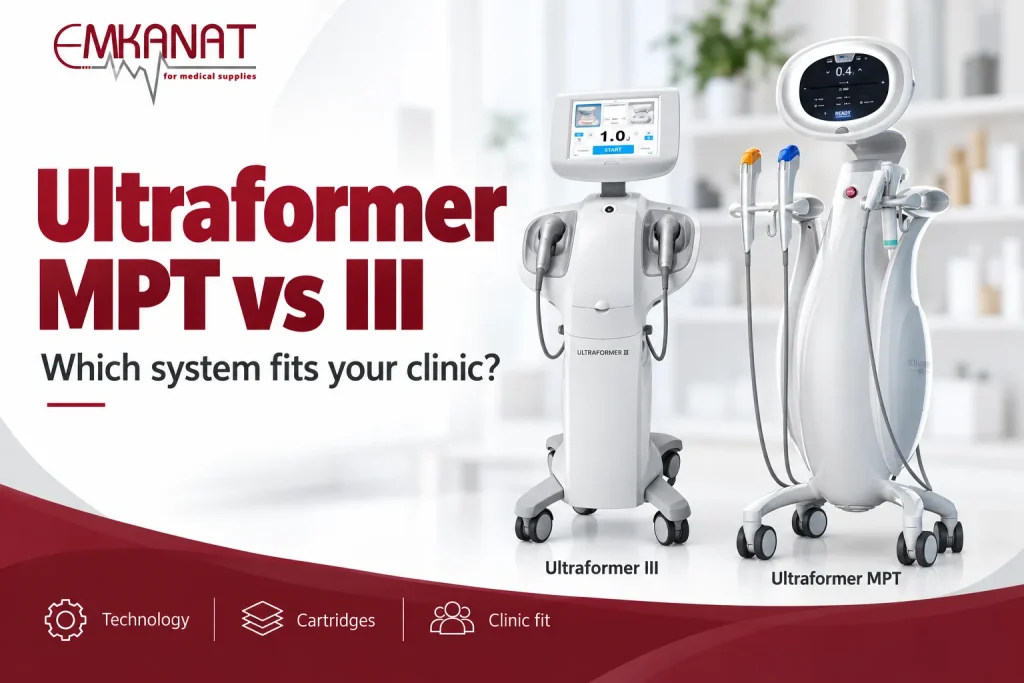
For a clinic comparing Ultraformer MPT vs Ultraformer III, the useful question is what each system would add to everyday practice. A longer feature list matters only when those features support the treatments your team is qualified to provide.
I would start with the clinic’s patient mix, treatment priorities and existing workflow, then examine the equipment and support required. This guide brings those decisions together. Emkanat supplies CLASSYS equipment and provides a route to discuss configurations, demonstrations and support; individual treatment decisions remain the responsibility of the treating practitioner.
Ultraformer MPT vs Ultraformer III: The Short Answer
Ultraformer III and Ultraformer MPT are CLASSYS focused-ultrasound systems. MPT adds delivery modes and handpiece options that may be useful for particular clinic workflows. Choosing between them requires a comparison of the supplied cartridges, intended applications, clinical evidence, training and ownership costs. Neither model is automatically the better investment for every clinic.
What Are Ultraformer III and Ultraformer MPT?
Ultraformer III
Ultraformer III uses micro- and macro-focused ultrasound, described by CLASSYS as MMFU technology. Its cartridge system provides options for different focal depths. The relevant comparison is how those documented capabilities fit the clinic’s intended services, operator training and patient population. Equipment selection still requires the current instructions for use.
See Emkanat’s Ultraformer III system page for product enquiries.
Ultraformer MPT
Ultraformer MPT belongs to the same focused-ultrasound family. MPT stands for Micro-Pulsed Technology, with additional energy-delivery patterns and applicator options described in the manufacturer’s documentation. These features expand the choices available to an appropriately trained operator. Their practical value depends on the configuration purchased and how the clinic plans to use it.
Emkanat’s Ultraformer MPT configuration and availability page provides the next step for equipment enquiries. Both models sit within its CLASSYS aesthetic systems portfolio.
Ultraformer MPT vs Ultraformer III: Technical Comparison
The table separates manufacturer-described features from the commercial information a clinic should obtain in writing. Global product options do not necessarily describe the package available in a particular market.
| Comparison point | Ultraformer III | Ultraformer MPT | Why it matters |
|---|---|---|---|
| Core technology | Micro- and macro-focused ultrasound. | Focused ultrasound with Micro-Pulsed Technology. | Both belong to the ultrasound category; neither is a laser. |
| Delivery options | Review the delivery options in the current model documentation. | CLASSYS describes four modes and linear F-type or circular Booster delivery. | Ask which options support your intended workflow. |
| Cartridges | Multi-depth cartridges, including the manufacturer-described MF2 option; request exact part numbers. | The global range lists 10 cartridge types. | Confirm what is included, optional and compatible. |
| Focal-depth options | Obtain the current supplied cartridge list and corresponding depths. | Face: 1.5, 2.0, 3.0 and 4.5 mm. Body: 6.0, 9.0 and 13 mm. Booster: 1.5, 3.0 and 4.5 mm. | These are specifications, not treatment instructions. |
| Applications | Check the intended uses for the exact model and market. | Check the intended uses for the exact model and market. | A global product description does not establish local authorization. |
| Workflow | Evaluate handling, setup and cartridge changes in a demonstration. | Evaluate handling, setup and cartridge changes in a demonstration. | Measure the complete process your team will follow. |
| Consumables | Obtain written cartridge-life and replacement terms. | Obtain written cartridge-life and replacement terms. | Purchase price alone cannot establish treatment cost. |
| Training and service | Confirm the local quotation’s inclusions. | Confirm the local quotation’s inclusions. | Support arrangements affect operation and downtime. |
Specification sources: CLASSYS Ultraformer III and CLASSYS Ultraformer MPT. Ask for a dated specification sheet and the current instructions for use with your quotation.
Ask Emkanat which Ultraformer configuration is available for your clinic and market.
What Do Cartridge Depths and Delivery Patterns Mean?
Focal depth describes where an ultrasound cartridge is designed to concentrate energy beneath the skin. Delivery pattern describes how that energy is distributed during operation. These specifications help an appropriately trained practitioner plan treatment, but a deeper cartridge or a larger selection of modes does not establish a better result by itself.
Facial anatomy and tissue thickness vary between regions and patients. A specification suitable for one objective cannot simply be transferred to another. I would ask a demonstrator to explain the purpose of each proposed accessory, its documented indications and the training needed to use it. That is more useful than comparing the maximum depth printed on two brochures.
Illustrative concepts only. This is not a treatment map, an anatomical scale or a comparison of outcomes.
Focal depth
Where energy is designed to concentrate beneath the surface.
Linear arrangement
A conceptual top view of a linear delivery pattern.
Circular arrangement
A conceptual top view of a circular delivery pattern.
Dot counts and spacing are schematic. Cartridge selection and operation follow the current instructions for use and practitioner training.
What Does the Clinical Evidence Actually Show?
Evidence for focused ultrasound
A 2023 systematic review by Contini and colleagues included 16 studies of microfocused ultrasound for facial tightening. It reported improvement in selected patients with mild to moderate laxity, while identifying variation in devices, protocols and outcome measures. Those findings provide context for the treatment category. They do not prove that MPT outperforms III.
Evidence specific to MPT
A 2024 retrospective study by Jong Seo Kim examined 50 patients at one clinic using three-dimensional measurements before and immediately after MPT treatment. It offers device-specific observations, but has no Ultraformer III comparison group. Immediate measurements cannot establish how long an individual result will last.
What remains uncertain
The sources reviewed here do not establish a universal clinical advantage for either model. Equally, that does not demonstrate that their outcomes are identical. Useful comparative evidence would assess similar patients, comparable protocols and meaningful follow-up. When reviewing photographs, keep those limitations in mind; our guide to how to assess Ultraformer results explains why consistent photography and realistic expectations matter.
Is MPT Faster, More Comfortable or Associated With Less Downtime?
Claims about speed, comfort and recovery need context. Faster energy delivery can affect one part of a procedure, while appointment length also includes assessment, preparation and aftercare. Comfort and recovery depend on the patient, treatment area and protocol. A manufacturer’s engineering comparison does not establish that one model is always clinically superior.
Delivery speed versus appointment time
CLASSYS states that MPT’s MP mode delivers energy 2.5 times faster than its normal mode. That comparison is within MPT. It should not be presented as evidence that a complete MPT appointment is 2.5 times faster than an Ultraformer III appointment.
During a demonstration, compare equivalent treatment objectives and record the entire workflow. Preparation and cartridge changes still occupy staff time.
Comfort and recovery
Ask what evidence supports a proposed comfort advantage and how discomfort was measured. Claims about less swelling or shorter recovery need comparable clinical data. Avoid assuming that every patient experiences a procedure in the same way, or that a shorter delivery phase guarantees an easier recovery.
Safety, Patient Selection and Treatment Limits
A qualified practitioner should assess the patient’s concern, medical history, anatomy and expectations before choosing a treatment. Mild laxity, substantial excess skin and volume loss present different clinical problems. An equipment purchase does not resolve those diagnostic decisions.
The microfocused-ultrasound review reported discomfort and transient redness or swelling, alongside less-common effects including altered sensation, bruising and burns. These findings should inform consent discussions without being turned into brand-specific complication rates.
Use the current instructions for use for contraindications, anatomical restrictions and operator requirements. A foreign clearance or global brochure does not establish what is registered in Jordan, Iraq or Syria. Claims such as “painless,” “zero downtime” or “suitable for everyone” are too broad to guide a responsible decision.
Training should cover assessment, treatment planning and recognition of adverse effects. Ask what instruction is available for the exact equipment being quoted, and how the clinic can obtain clinical or technical assistance when questions arise.
Clinic Workflow, Cartridges and After-Sales Support
Daily operation
Handle the equipment before deciding. Can the operator position the handpiece comfortably? Are cartridge changes straightforward? Does the proposed room meet the manufacturer’s installation requirements? Review setup, approved cleaning procedures and the documentation your team will need. A demonstration should resemble the clinic’s expected work, including its less convenient practical details.
Cartridge supply and usage
Request compatibility, usable-life and replacement information for every cartridge in the quotation. Confirm how usage is counted, what triggers replacement and whether storage or expiry conditions apply. Ask the supplier to explain how shots or lines are defined across delivery modes before comparing costs on that basis.
Supply also matters. A cartridge that is difficult to replace can disrupt appointments even when the console works perfectly. Establish ordering lead times and who will monitor remaining usage and inventory.
Training, maintenance and service
Clarify installation, initial operator training, refresher options, preventive maintenance and spare-parts arrangements. Ask how service requests are handled and what the warranty excludes. These details belong in the purchasing decision alongside the hardware. Emkanat’s equipment team can discuss demonstrations, training and maintenance enquiries; the quotation should specify the agreed scope for your location.
Ultraformer MPT vs III Cost: Compare the Whole Ownership Commitment
Equipment purchase prices and patient treatment fees answer different questions. A treatment price from another country tells a clinic little about the cost of buying, maintaining and operating its own system.
Compare quotations that identify the console, handpieces, cartridges, installation, training, warranty and service. Include financing costs where relevant. Then calculate a treatment cost using verified cartridge consumption, disposables, staff and room time, and an appropriate allocation of capital and maintenance costs.
Use your clinic’s records to assess likely demand. A busy service may justify different equipment choices from one still being established. I would be cautious about any calculation that assumes higher treatment fees, full appointment books or guaranteed payback simply because a device is newer.
For clinics researching medical aesthetic equipment in Jordan, local quotation scope and support arrangements are more useful than overseas price estimates.
Request a written breakdown of cartridges, training, warranty and service terms.
Which System May Fit Your Clinic?
The better fit is the system whose documented capabilities match the clinic’s intended services, qualified staff and operating requirements. An upgrade becomes easier to justify when it solves a specific limitation. Compare what your team can use effectively, the evidence relevant to those applications and the complete quotation before deciding.
When Ultraformer III may remain appropriate
III may suit a clinic whose intended applications align with its verified configuration and whose staff have an established workflow. Confirm availability and service terms. Its place in the comparison should not depend on assumptions that an older model is automatically cheaper or obsolete.
When MPT may merit consideration
MPT deserves consideration when its documented modes or additional applicator options address a practical need. Ask the demonstration to show that benefit, then weigh it against training and ownership requirements. Buying every available accessory is unnecessary if the clinic has no intended use for it.
When upgrading may not be justified
If existing equipment meets the clinic’s needs, an upgrade may add little immediate value. Limited demand, unresolved training needs or uncertain support can also change the decision. Where the main clinical priority requires another treatment category, neither Ultraformer model may be the appropriate purchase.
Questions to Ask Before Buying or Upgrading
- Which exact model, handpieces and cartridges are included?
- Which applications are registered in the intended country?
- Can I review the current instructions for use and specification sheet?
- What is each cartridge’s documented usable life and replacement cost?
- What operator qualifications and training are required?
- What installation requirements apply?
- What warranty and preventive maintenance are included?
- Who provides technical support, and what are the written service terms?
- Are replacement cartridges and spare parts available locally?
- Can we arrange a demonstration of the proposed configuration?
- What costs fall outside the quotation?
Request an Ultraformer quotation
Frequently Asked Questions
What is the difference between Ultraformer III and Ultraformer MPT?
Both are CLASSYS focused-ultrasound systems. MPT adds Micro-Pulsed Technology and further delivery and applicator options. For a clinic, the meaningful comparison includes the exact cartridges, intended applications, workflow, training and ownership costs. Those differences should be assessed separately from claims that one model produces better results for every patient.
Are Ultraformer III and MPT both HIFU devices?
Yes. Both belong to the high-intensity focused ultrasound category. Ultraformer is a product family, while HIFU describes the underlying energy technology. Their names identify different systems within that category. Neither is a laser, and their documented applications and operating requirements should be checked for the exact model and market.
Is Ultraformer MPT always better than Ultraformer III?
No. Additional features can be useful when they match a clinic’s needs, but they do not establish superior results in every situation. The evidence reviewed here does not support a universal winner. Patient selection, documented indications, operator expertise and the configuration actually purchased remain part of the decision.
Does Ultraformer MPT require less treatment time?
It depends on the mode, treatment objective and workflow. CLASSYS compares MPT’s MP-mode delivery speed with its normal mode; that is not a complete appointment comparison with III. Assessment, preparation, treatment-area coverage, cartridge changes and aftercare also contribute to the time a clinic needs to allocate.
Can both systems be used for the face and body?
CLASSYS describes facial and body applications within the Ultraformer range, with different cartridge options. A clinic should confirm which accessories and uses apply to its exact system and country. A body cartridge or global product description does not authorize every proposed treatment or replace an individual medical assessment.
How can a clinic compare prices or request a demonstration?
Contact Emkanat with the clinic’s country, intended applications and whether you are buying a first system or considering an upgrade. Request a written configuration, cartridge and service breakdown, then discuss a demonstration. Compare equivalent equipment packages and support terms rather than using patient session prices as a purchasing benchmark.
Choose the Configuration Your Clinic Can Use Well
A useful Ultraformer MPT vs Ultraformer III comparison ends with a clearer purchasing decision. Match the system to the clinical work, examine the evidence and confirm the equipment, consumables and support in writing.
Speak with Emkanat about your treatment mix, preferred configuration and equipment requirements, so the discussion begins with what your clinic needs.